The Ernst Hadorn Foundation awards Transitional Fellowships in the University of Zurich since 2024.
Overview
The 2025 Ernst Hadorn Fellows pursue ambitious research in cancer biology, immuno-oncology, developmental programmes, and gene editing, bridging fundamental discovery with translational relevance.
Ernst Hadorn Fellow 2025
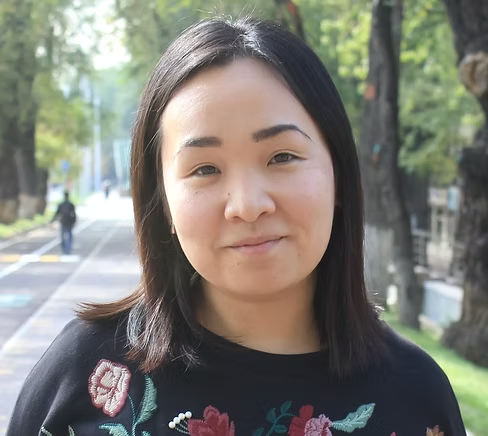
Aizhan Tastanova, PhD
Aizhan Tastanova studied medicine and earned a PhD in synthetic biology at ETH Zurich, where she engineered gene networks in designer cells to sense cancer-associated signals. She then pursued translational oncology research at the University of Zurich and University Hospital Zurich, focusing on immuno-oncology and cutaneous lymphomas as a model system to study T-cell plasticity and therapy resistance.
Thanks to the Ernst Hadorn Transitional Fellowship, Aizhan will apply single-cell multiomics, spatial transcriptomics, and functional assays to investigate how malignant T cells adapt to therapy through epigenetic and microenvironmental cues.
Using single-cell and spatial multiomics together with functional perturbations and modeling in 3D tissue culture models, she aims to uncover how resistant T-cell states arise, identify biomarkers of therapy resistance, and develop strategies to reprogram these cells into therapy-sensitive states.
Ernst Hadorn Fellow 2025
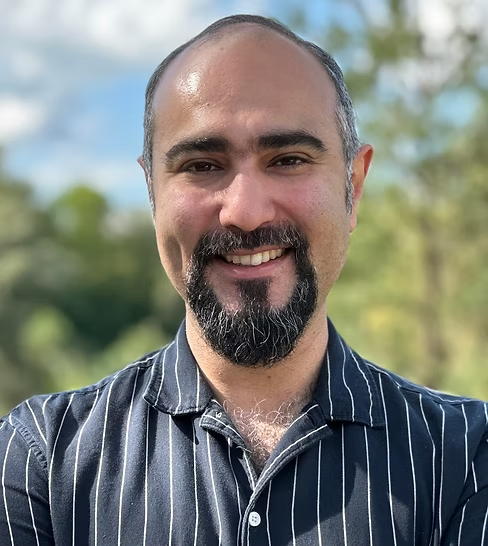
Hassan Fazilaty, PhD
Hassan Fazilaty is a molecular biologist specialized in cancer, development, and stem cell biology. After earning his PhD cum laude in Molecular Biosciences from the Universidad Autónoma de Madrid, Spain, he moved to the Department of Molecular Life Sciences at the University of Zurich for his postdoctoral research.
He is currently employed as Research Associate and is leading projects on reawakened embryonic genetic programs in tissue regeneration and cancer.
With support from the Ernst Hadorn Foundation, Hassan will investigate reactivated embryonic programs in colorectal cancer, one of the most aggressive cancers among young adults. By comparing embryos and tumors side by side, he aims to uncover which developmental pathways are hijacked by cancer cells and identify their weak points.
The ultimate goal is to design therapies that specifically target these oncoembryonic pathways, shutting down cancer’s adaptability while sparing healthy tissues.
Ernst Hadorn Fellow 2025
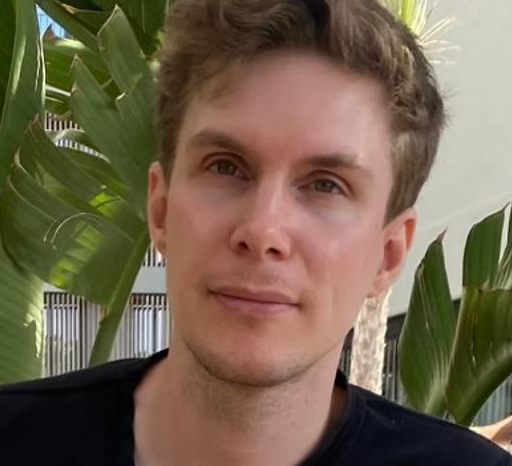
Lukas Villiger, MD PhD
Lukas Villiger is a physician scientist working on gene editing and delivery. After completion of his PhD from ETH Zürich, he continued his postdoctoral training at MIT.
As a postdoctoral fellow, he will now try to understand how retrotransposons copy and paste themselves and how they might be repurposed for large gene insertion.
With generous support from the Ernst Hadorn Foundation, Lukas plans to identify and reprogram retrotransposons to apply them for immune cell engineering and therapeutic applications in genetic disease models in vivo.
The goal is to help develop new approaches for large gene insertion with high on-targets and minimal side effects.